Interview with Magnus Westrin
Magnus Westrin was born the same year that Hermes Medical Solutions took root, 1976. Both born in Stockholm, Sweden and both now at their prime at 50 years young, let’s learn more about the man overseeing the financial health of Hermes Medical Solutions, its deputy CEO and CFO.
Magnus, could you please briefly introduce yourself?
I am an ingrained Stockholmer, with both my parents and all my grandparents also from the Stockholm region. I have, however, always felt the urge to explore the world beyond the 14 islands that make up Stockholm (plus the 24,000 in the Stockholm Archipelago).
My early exploration took me to high school in the USA, in Massachusetts, and later to MBA studies in Chapel Hill, North Carolina. These experiences turned me into a devoted Patriots and Tar Heels fan, as well as someone always on the lookout for a bar serving chicken wings with creamy blue cheese dip.
My curiosity about the world also led me to the sea, where I spent five years in the Swedish Navy, earning the rank of Lieutenant while traveling across the Baltics and the North Sea.
After returning to my Swedish roots and completing my studies at the Stockholm School of Economics, I began my corporate journey with Booz Allen, a management consultancy firm. There, I was quickly exposed to MedTech and immediately recognized the industry’s appeal—working for the greater good while making a tangible difference on an individual level, even without a scientific background.
My journey then took me to one of Sweden’s most successful MedTech companies, Elekta. There, I spent several years collaborating closely with neurosurgeons and oncologists on a global scale, understanding reimbursement in Tokyo, market potential in Johannesburg, and service demands in Istanbul.
One of the benefits of exploration is the journey within yourself. In the end, I realized two things: I am a Stockholmer, and I want to make a real impact. So, when the opportunity came to join Hermes Medical Solutions and enter the field of nuclear medicine and molecular imaging, I knew I had found my home.
What do you do at Hermes Medical Solutions?
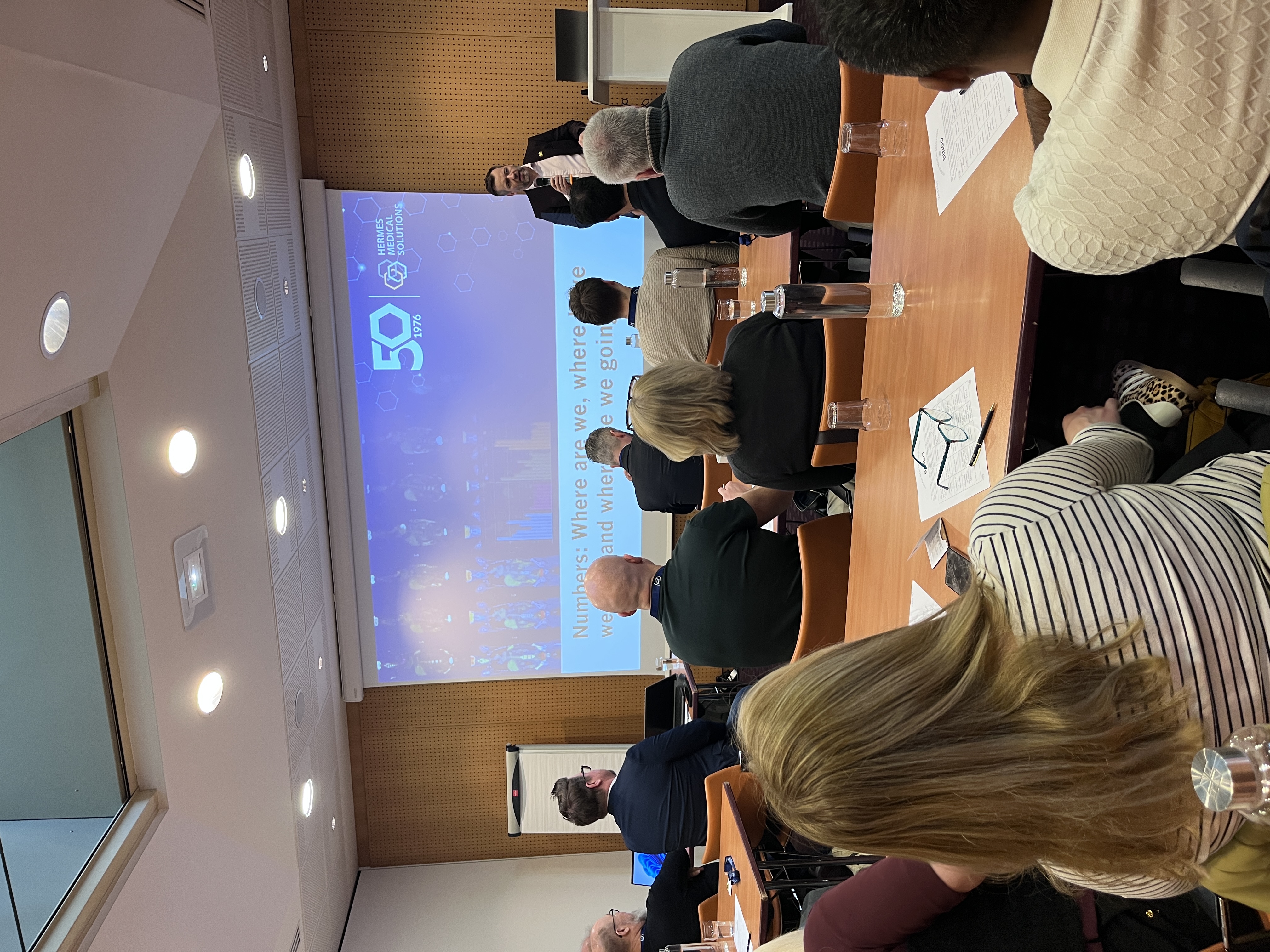
I often refer to Hermes Medical Solutions (HMS) as a small company, mainly to emphasize the importance of people who put the company first. Since I have the privilege of leading a strong finance team that manages daily operations independently, I can focus on areas that help HMS become the best possible partner in nuclear medicine and molecular imaging.
If that means making sure we have enough coffee to support the average five cups consumed by Swedish workers each day, then that’s what I’ll do.
In recent years, as HMS has grown rapidly, I’ve spent significant time supporting talent acquisition and contributing to business development, particularly around product offerings and partnerships.
From my time in the navy, I learned that some ships performed better than others, even if they were technically identical. The difference was the team. In naval terms, it’s called “a happy ship.” That’s what I strive to create at HMS—a strong sense of togetherness and a collaborative culture.
What makes Hermes Medical Solutions unique?
Hermes Medical Solutions’ greatest strength is our focus. As a growing company, it’s easy to spread yourself too thin by expanding in too many directions. HMS is, and will continue to, focus on software for nuclear medicine.
It’s the perfect niche because NM/MI is highly complex and requires deep expertise. Without a clear focus, it becomes difficult to truly meet users’ needs.
Another unique aspect of HMS is the depth of clinical knowledge within the company. More than 50% of our employees, and 100% of our support staff, have clinical backgrounds. I’ve never encountered another company where the understanding of its users is so profound.
You and Hermes Medical Solutions both turn 50 this year. How does that feel?
Someone once told me that until you’re 40, you’re building your career, and after that, you’re doing your career. I agree with that. At first, you gather tools, but eventually you reach a point where you can use them together to create something meaningful on a larger scale.
I think that’s something HMS and I share. Over the years, we’ve built the tools and expertise, and now we can truly benefit from them.
With age also comes clarity, understanding who you are and what really matters. Sometimes, the most important decision is to say no. For us, that means staying focused on vendor-neutral NM/MI software. That’s also where I believe I can contribute, knowing where to focus.
What are the advantages of vendor-neutral software?
I struggle to see why you would choose anything else. The biggest benefit is freedom. You’re never locked into a specific hardware vendor.
In a rapidly evolving field like ours, new players will continue to emerge on both the hardware and software sides. It’s unlikely that one company will lead in both simultaneously, so being able to choose the best of each is key.
We’re working in cycles of 5–10 years, and a lot can change in that time.
Another advantage is efficiency. Using the same software across systems creates a consistent user environment and improves workflow.
From a financial perspective, vendor neutrality also provides transparency. A clear breakdown of costs helps optimize spending and streamline operations.
Can you imagine the next 50 years of nuclear medicine?
With my background in oncology, I see a strong overlap with nuclear medicine, especially in theranostics, which brings diagnosis and treatment closer together.
There are still many open questions, such as workflow ownership within hospitals, and we already see differences between Europe, Canada, and the USA. It will be interesting to see how this develops.
I believe the line between diagnosis and treatment will continue to blur, fundamentally changing how care is delivered.
Another area of great interest is neurodegenerative diseases. This could drive demand for new types of brain imaging equipment, perhaps more specialized, head-focused scanners to meet increasing needs.
For us, the focus remains on providing the best tools—combining efficiency and performance to meet growing demand.
Then there’s AI. Today, we are rightly constrained by regulatory requirements, as MedTech is a cautious industry. But over time, established AI technologies will likely be implemented, bringing significant changes, particularly through automation.
And as always, we will stay focused. With our expertise, I’m confident there will continue to be a strong place for us in the future.